

Treatment for Nasolabial Folds in Women in Their 40s and 50s: How to Choose Between Filler and Lifting
This post is medical advertising written by this clinic for the purpose of providing medical information. It complies with Article 56, Paragraph 1 of the Medical Service Act.
Have you ever looked in the mirror one day and noticed that the lines running from the sides of your nose to the corners of your mouth looked unusually deep? One concern frequently raised by women in their 40s and 50s during consultations is Nasolabial Folds, which can make the face look tired and older. However, even with the same Nasolabial Folds, the choice between Filler and lifting depends on what caused them to deepen.

Below, we explain in order why Nasolabial Folds deepen, how Filler differs from lifting, and what to check before choosing a treatment for natural-looking improvement.
Three Reasons Nasolabial Folds Deepen

Nasolabial Folds are a natural contour of the face that runs from the sides of the nose to the corners of the mouth. As we age, skin elasticity decreases and the fat and soft tissue in the cheeks change, making this contour increasingly pronounced. This is also why women in their 40s and 50s may become much more conscious of their Nasolabial Folds.
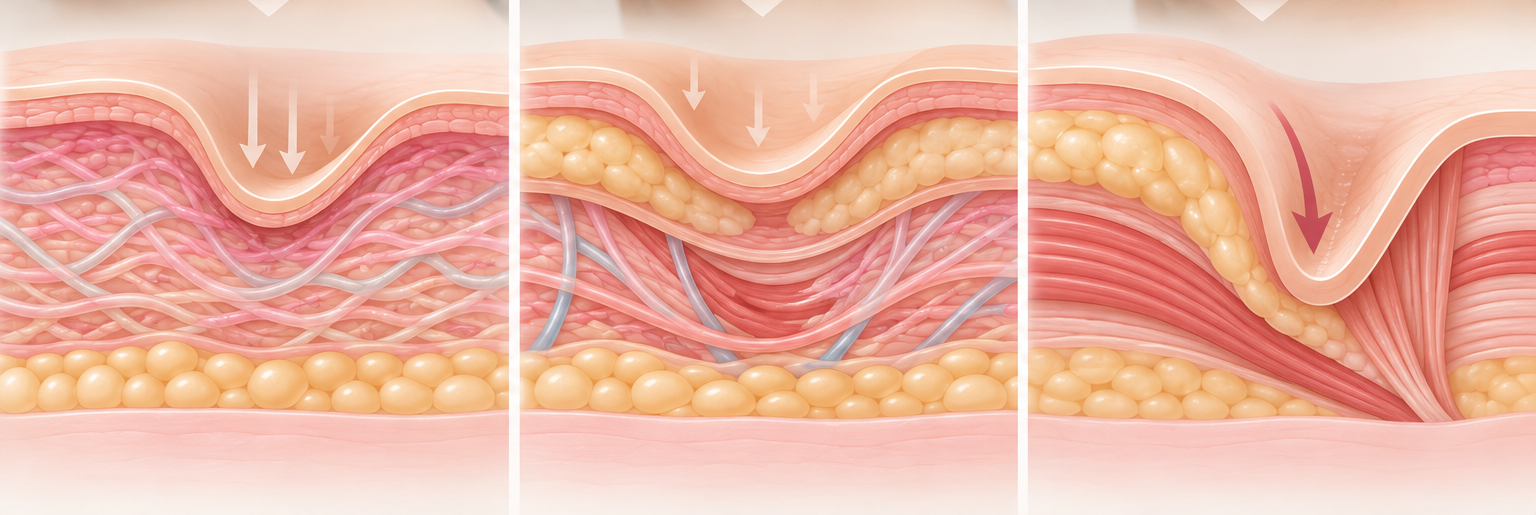
- Loss of skin elasticity — Changes in collagen and elastic fibers weaken the skin’s support, making Nasolabial Folds look deeper.
- Sagging of the cheeks — When the tissues of the midface descend, shadows form above the Nasolabial Folds, making the wrinkles more prominent.
- Changes in facial volume — When volume in the front cheekbones or beside the nose decreases, the difference in height from the surrounding areas increases, making Nasolabial Folds more noticeable.
So, deep Nasolabial Folds do not necessarily mean that the lines themselves should be filled right away.
Nasolabial Fold Filler and Lifting Address Different Concerns

The two options most often compared for Nasolabial Folds are Filler and lifting, and they target different concerns.
Nasolabial Fold Filler — Restoring Lost Volume
Nasolabial Fold Filler is a method of restoring insufficient volume with hyaluronic acid Filler or similar products. It may be selected when hollowing beside the nose or around the Nasolabial Folds is the main cause. However, increasing the amount indiscriminately can make the face look unnatural or cause one area to protrude, so the injection site and amount are determined carefully.
Lifting — Improving the Firmness of Sagging Tissue
Lifting may be considered when sagging skin and soft tissue make Nasolabial Folds more prominent. Ultrasound- and radiofrequency-based lifting is used with the aim of improving firmness, depending on the condition of the skin, but it is difficult to completely erase Nasolabial Folds that are already deeply established.
If sagging and volume loss occur together, either Filler or lifting alone may not be enough. Ultimately, the starting point for choosing a treatment is to first identify why the Nasolabial Folds look deep, rather than deciding which treatment is better.
What to Check Before Nasolabial Fold Treatment

Nasolabial Folds move whenever you smile or speak, so it is important to look not only at your face at rest but also at how it looks when your expression changes. Before choosing Filler, the skin thickness, distribution of facial volume, and left-right asymmetry are checked in advance.
Important blood vessels pass around the Nasolabial Folds, so particular care is needed during treatment. Bruising, swelling, and inflammation may occur after Filler injections, and, in rare cases, serious complications such as skin necrosis or vision loss may occur due to vascular occlusion. We recommend making your choice only after fully understanding not just the changes you hope to see, but also the treatment’s limitations and risks.
When treating Nasolabial Folds, I place greater importance on preserving overall facial balance and natural expressions than on completely eliminating the wrinkles.
Nasolabial Fold Filler and Lifting: FAQ

How many cc of Nasolabial Fold Filler is appropriate?
The amount needed varies depending on the depth of the Nasolabial Folds and the condition of the facial volume. Rather than using a fixed amount as is, the plan is based on the injection site and the balance of the surrounding tissues.
How long does Nasolabial Fold Filler last?
How long it lasts varies depending on the product’s characteristics, the injection site, and an individual’s metabolism and lifestyle habits. The effect may diminish over time, and it is difficult to predict the duration uniformly.
If my Nasolabial Folds are deep, should I get Filler and lifting together?
Not necessarily. If volume loss and sagging occur together, both methods may be considered, but depending on the skin condition and the desired changes, one method alone may be sufficient.

In Summary
Whether to choose Filler or lifting for Nasolabial Folds depends on which factor is most significant: loss of skin elasticity, sagging cheeks, or changes in volume. Filler may be considered when hollowing is the main concern, lifting when sagging is the main concern, and a combination when both are present. Since the area contains blood vessels, safety and overall facial balance must also be considered. If you are a woman in your 40s or 50s and are wondering which factors are affecting your Nasolabial Folds, you may discuss this during a consultation.
Request a consultation [blocked]
Reviewed by: Dr. Kwon Yu-ri · Board-Certified Family Medicine Physician, Academic Director of the Korean Melasma Society | Last reviewed October 25, 2026
This content is intended to provide medical information, and effects and side effects may vary from person to person. Please consult with a member of the Medical Team to determine an accurate diagnosis and whether treatment is appropriate. This post is identified as medical advertising under Article 56 of the Medical Service Act.