
Laser Options for Acquired Ota Nevus
If you have tried to clear dark patches on your face with whitening treatments or toning but have not seen good results, it may help to first understand what kind of pigmentation an acquired nevus of Ota is and how it should be approached.
When pigmentation does not improve with whitening treatments
When dark pigmentation appears, many people assume it is simply melasma or blemishes and try general whitening Skin Care or toning. However, in cases like this, the pigment is more likely to be located in the deeper dermis rather than the epidermis.
When pigment lies deep in the dermis, it can be difficult to reach the lesion with standard energy delivery alone. So when looking into a Laser for an acquired nevus of Ota, it is important to check not simply how well it can lighten the color, but how reliably it can address pigment in the deeper layers.
A stable change is difficult to achieve with an approach that does not take the lesion’s depth and characteristics into account.
What kind of pigmentation is an acquired nevus of Ota?
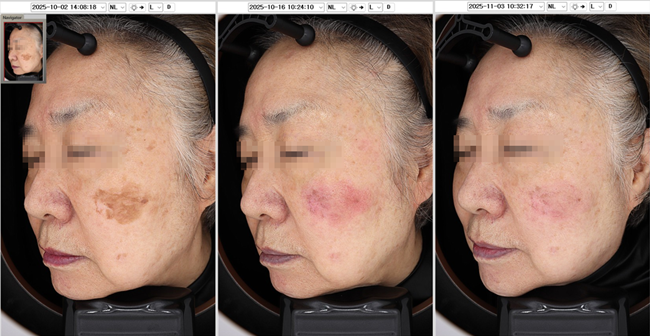
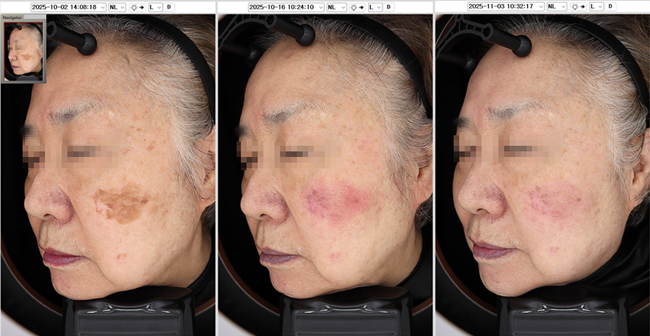
An acquired nevus of Ota, as it is commonly called, refers to grayish-blue or blue-brown patches that usually appear after adolescence around the cheekbones, forehead, or temples. It is a condition in which melanocytes abnormally proliferate and settle in the dermis, much deeper than the epidermis.
As light scatters through pigment deep in the skin, it appears bluish or tinged with gray. It usually causes no noticeable symptoms such as pain or itching and poses no major health risk, but it can make the complexion look dull and can be a significant cosmetic concern.
Sun exposure, hormonal changes, and genetic factors are known to contribute in combination, so these characteristics should also be considered when choosing a Laser.
Re-POT Laser, focused on dermal pigment
Treating pigment deeply settled in the dermis requires technology that concentrates energy on the lesion. One option to consider is the Re-POT Laser, which uses a 532nm wavelength.
Re-POT incorporates VSLS technology, which protects blood vessels and helps guide pigment Skin Care. Strong energy delivery can sometimes cause inflammation or redness due to thermal damage.
Re-POT is designed to control thermal energy so that it does not cause damage that is Not required to the tissue, while reacting only with the targeted pigmented lesion. This is a different approach from conventional methods and may help address the lesion itself. Depending on the location of the pigment, we may first consider Re-POT for precise pigment Skin Care.

Contact cooling to protect the skin
One feature of the Re-POT Laser is its contact Cooling system. When comparing Lasers for an acquired nevus of Ota, it is important to consider how effectively the skin is protected when high energy is used to treat the lesion.
The Re-POT handpiece cools to a very low temperature as soon as it touches the treatment area, lowering the surface temperature. Cooling the skin helps reduce the risk of thermal damage, such as post-inflammatory hyperpigmentation or burns, and creates conditions for delivering higher energy more reliably.
As a result, it provides a basis for addressing even deeply situated pigment more reliably, which also has a positive effect on the recovery process.
StarWalker, addressing pigment by layer
StarWalker Laser may also be considered to enhance the synergy of pigment Skin Care. It is a multi-functional Laser designed to selectively target melanin pigment while reducing damage to the surrounding healthy tissue.
StarWalker is equipped with modules using multiple wavelengths, allowing the energy intensity and penetration depth to be adjusted according to the location of the lesion. This makes it suitable for a wide range of concerns involving uneven tone, including challenging conditions such as acquired nevus of Ota and melasma. For pigment present across mixed layers, StarWalker for addressing pigment by layer can be particularly useful.
How pigment is broken down into tiny particles
StarWalker works by using the property of melanin to selectively absorb specific wavelengths. Through the photoacoustic effect, which delivers strong energy over a short period, clumped pigment particles are broken into fine, powder-like particles to help the body eliminate them. Key features include:
- Customized treatment by depth with Q-switched and picosecond modes
- Broad coverage, from shallow epidermal pigment to deep dermal lesions
- ASP technology evenly adjusts the beam’s energy distribution
- Prevents excessive concentration, reducing the burden and variations in results
Pigmentation may look similar on the surface, but its depth and cause can vary. So rather than judging by what is visible alone, it is important to first check the condition beneath the skin and then determine the wavelength and intensity.
Pigment located deep in the dermis, as in an acquired nevus of Ota, is particularly unlikely to be resolved with a single Treatment. It is less burdensome to proceed gradually over several sessions, allowing the pigment to fade over time while checking recovery. Thorough sun protection between Treatments is also an important habit that helps prevent the pigment from darkening again. Above all, avoiding picking or rubbing areas with scabs during recovery can help prevent marks from remaining.

Skin Care starts with diagnosis
Successful pigment Skin Care begins by understanding not only the visible lesions but also the condition beneath the skin. In the consultation room, I first examine the skin with the MARK-VU diagnostic device, which uses 4 light sources, and then recommend only the approaches that are truly needed.
Even after treatment is complete, I continue aftercare by explaining how to care for the bandage and providing ongoing feedback, helping reduce the burden and maintain changes over time. If lighter-toned pigmentation or other lesions are also present, we may also consider RevLite for broad-area pigment Skin Care.
If you have questions, feel free to send them through Chat with us now [blocked].
💬 Get a consultation [blocked]
Reviewed by: Dr. Kwon Yu-ri · Board-certified family medicine specialist, Academic Director of the Korean Melasma Society
First published 2026-02-05 · Last reviewed 2026-07-03
This article is provided for general informational purposes. Treatment methods and results may vary depending on individual circumstances. Please consult the Medical Team for an accurate diagnosis and consultation.